

Where Terra Cotta Meets Glass: A New Edge for South San Francisco
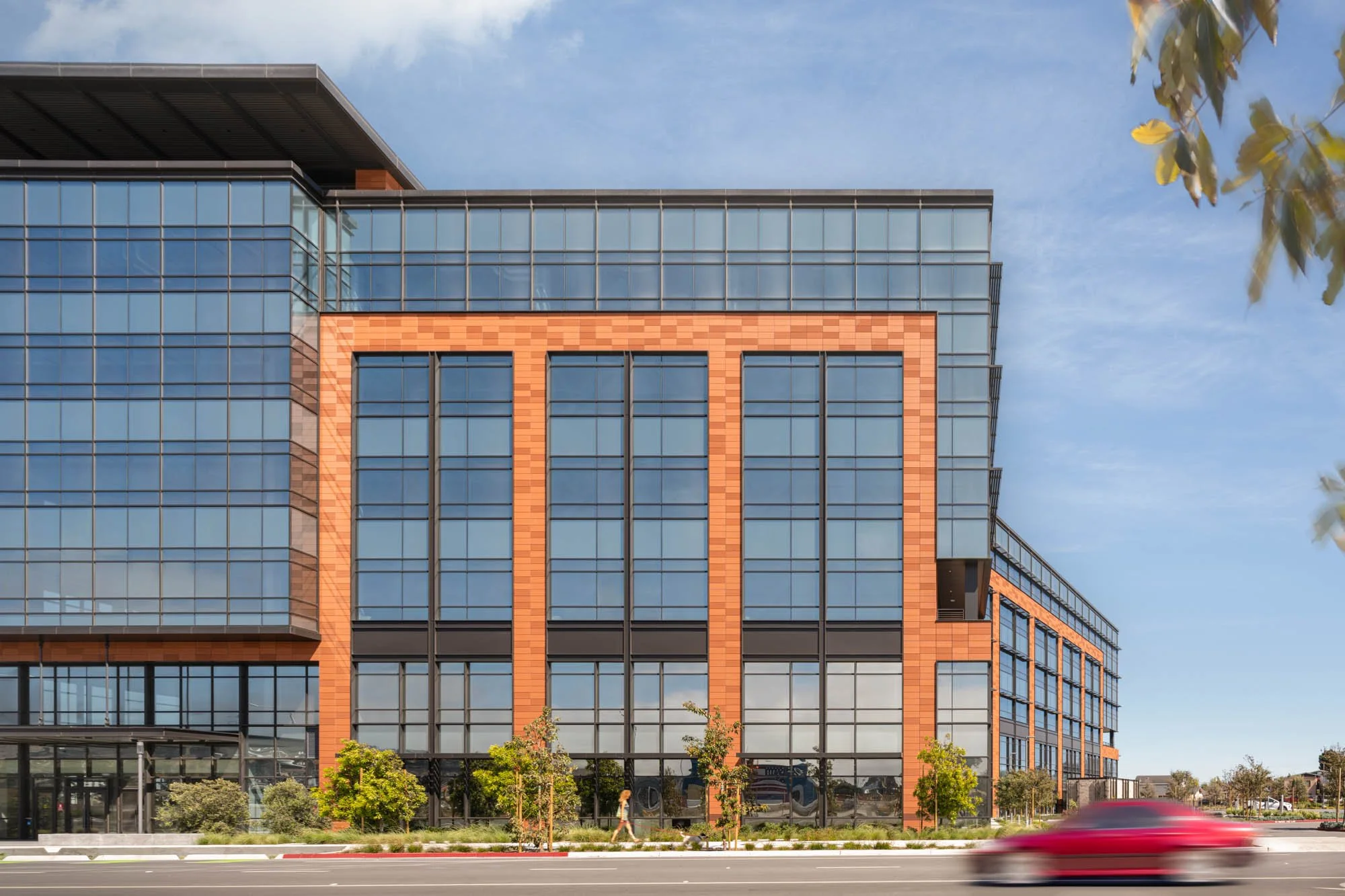
Southline sits in a part of South San Francisco that has shifted dramatically over the years. What was once a patchwork of aging industrial warehouses is now becoming a transit-connected district for biotech, commercial, and R+D tenants. My role was to help document that shift—showing how the materials, massing, and site planning work together to create something that feels rooted yet forward-looking.
The heart of this story is the façade. Terra cotta is an ancient material, but here it’s precision-modeled and fabricated to meet tight tolerances—something you don’t normally associate with baked clay. Next to the glass curtain wall, it becomes a conversation between earthy texture and sky-reflective surfaces. My goal was to make that relationship legible across a full day of shifting light and fog.
Project Overview
Project: Southline
Project Type: Core & Shell
Building Type: Life Science Workplace
Location: South San Francisco, CA
Photography Year: 2025
End Client: Lane Partners
Architect: DES Architects + Engineers
General Contractor: DPR
Key Partners: NBK (terra cotta manufacturer), Walters & Wolf (curtain wall contractor), B.T. Mancini (terra cotta installer)
Photography Scope: Exterior Architectural Photography
Client Use: Portfolio, Online and Print Marketing, Client Presentations + Proposals
Photographer: Rob Calderwood Architectural Photography (San Francisco Bay Area)




Design Story
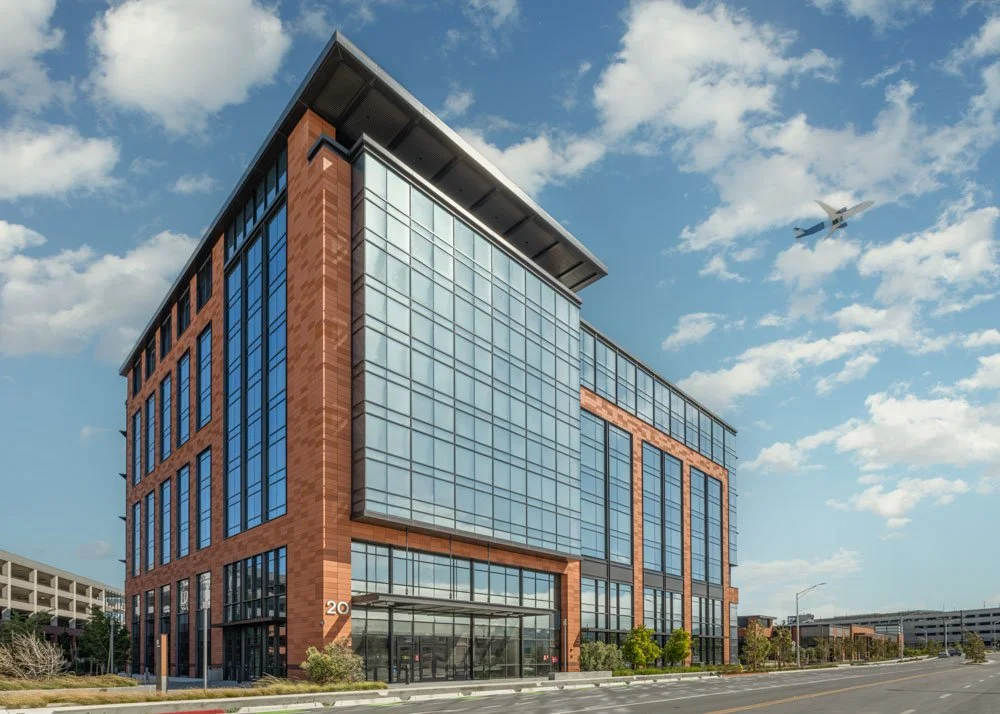
The design team pushed for clarity and material honesty. Terra cotta rainscreen modules from NBK stand next to broad panes of glass, each material doing something different for the building’s presence on this evolving corridor. The warm clay tones and the darker metal accents nod to familiar Bay Area industrial structures—brick edges, steel frames—while still reading as a modern commercial campus.
Another part of the design story sits at the site scale. Southline transitions from a single-family neighborhood on one side to mid-rise commercial buildings on the other. Instead of creating a hard divide, the team introduced a public strip park and a garage wrapped in botanical artwork. Tenants and neighbors both gain from that shared edge: it softens the shift and adds a layer of community access that the old warehouse district never had.
An amenities building rounds out the plan. While it primarily serves future tenants, its design allows for broader community use—public events, informal gatherings, or spillover activity from adjacent transit riders.
Constraints & Opportunities
Fog is a constant character in this part of South San Francisco. It can roll in quickly, thin out, or stay dense for hours. That variability influenced both design and photography, since the façade takes on completely different qualities depending on how bright or diffuse the light is.
Wind was another factor—strong enough at times to make long exposures tricky. And with the building not yet occupied, I needed to balance overall views with smaller moments that gave scale and usability to otherwise empty scenes.
A few of the constraints and opportunities that shaped the shoot:
Rapidly shifting fog altering reflections and surface color
Strong winds requiring stabilization for long exposures
Mid-construction context still evolving around the site
No occupants yet, prompting creative ways to show scale
A long building perimeter offering multiple vantage points with changing sun angles
How We Approached the Shoot
I stayed onsite most of the day to take advantage of the changing fog patterns. That meant revisiting the same views at multiple times to catch the terra cotta’s tonal variations and the glass reflections when the sky opened up.
Since the building wasn’t yet occupied, I occasionally stepped into the frame to provide a sense of height and proportion. When passersby crossed the strip park, I worked them into the composition too—they helped tie the development back to the neighborhood it’s joining.
Key parts of the approach included:
Coordinating timing to capture moments of sky reflection vs. diffuse fog
Using long exposures stabilized with the tripod weighted by my camera bag
Switching between wide views to show massing and tight vignettes to highlight joinery and material alignment
Shooting late-afternoon sequences when the warm façade and cooler glass contrast became strongest
Image Highlights
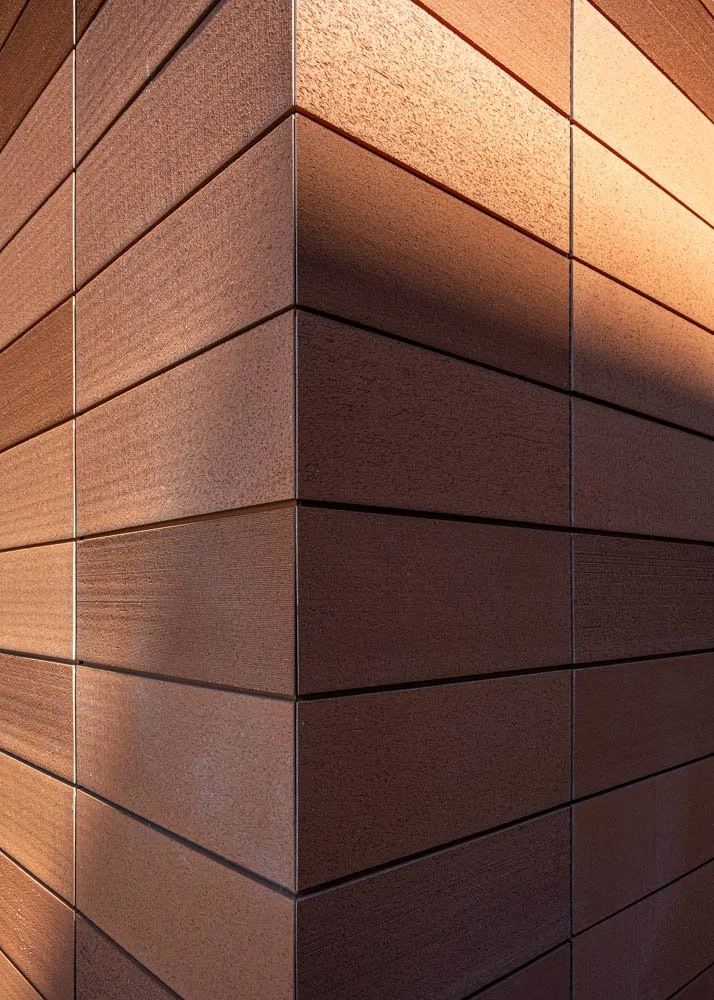
One of the most telling views is the corner where the terra cotta miter meets the curtain wall. These tiles were modeled by Neme Design Studio so their vertical joints align precisely with the mullions—a level of rigor you rarely see with a clay-based system. Photographing this meant waiting for directional light that could skim across the edges without blowing out the highlight on the glass.
Another sequence focuses on the alternating textures: terra cotta, dark metal, and glazing. When the fog thinned, reflections of the sky set a soft blue backdrop against the orange tones. That contrast helps explain the architect’s intent better than any technical description.
A third grouping of images follows the pedestrian edge. Here, the strip park, the public art on the garage, and the frontages all interact to create a usable threshold between home and workplace. Showing this meant spending time at human eye level and catching people naturally moving through the space.
Detail shots round out the gallery—joint alignments, shadow patterns, surface texture—because these are the moments manufacturers and façade consultants often highlight in their own portfolios.
Results & How the Client Uses the Images
Construction Specialties and Neme Design Studio are using these images across their marketing channels to show how complex façades come together in real conditions. The photos also support proposals, RFP packages, and future manufacturing case studies—especially for clients who want to see how precision terra cotta behaves next to high-performance glazing.
The developer and design team gain material as well: images that speak to leasing efforts, project positioning, and the broader narrative of the district’s transformation. For anyone shortlisting an architectural photographer in the Bay Area, this project also illustrates how we handle reflective materials, variable weather, large sites, and technical façade systems.
📌If you’re wrapping up a project in the Bay Area and need publication-ready photography, you’re welcome to reach out through the contact page. You can also browse related workplace and commercial projects in the portfolio.
Key Takeaways
Terra cotta and glass create a clear material dialogue that’s easy to see at different times of day.
Tight fabrication tolerances—especially at the mitered corners—are a significant part of the story.
Frequent fog shaped the photographic approach and helped reveal surface variations.
Winds required stabilization strategies during long exposures.
Public park space and garage artwork soften the transition between residential and commercial zones.
The amenities building supports tenants while opening possibilities for community use.
Daytime and late-afternoon sequences best captured the contrast between warm terra cotta and sky reflections.
Images can support portfolios, proposals, RFPs, leasing materials, and manufacturer marketing.